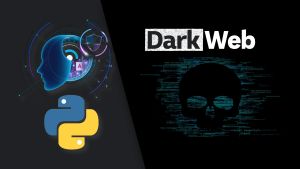

The Dark Web is often portrayed as a mysterious place populated by cybercriminals and marketplaces for illegal goods. In reality, for those working in cybersecurity and threat intelligence, it represents a massive source of valuable data: forums where stolen credentials are sold, corporate database dumps, Ransomware-as-a-Service ads, and much more.
Monitoring these spaces systematically and securely allows threat intelligence teams and SOCs to gain precious time: discovering leaks before data is published, anticipating new attacker TTPs, and enriching detection with real-time indicators.
In this article, we will explore 5 practical techniques for monitoring the Dark Web, with concrete examples of tools, small scripts, and automation pipelines. The goal is not to "browse out of curiosity," but to understand how a SOC or an incident response team can integrate this information into its detection and defense processes.
1. Custom .onion Crawlers
The starting point for exploring the Dark Web is creating a small crawler capable of visiting hidden services and downloading content of interest.
From a technical standpoint, it's enough to configure Tor as a local proxy and use a library such as Stem for Python or simple HTTP requests routed via SOCKS5. This setup allows you to create scripts that connect to .onion addresses, download pages, and save them locally for later analysis.
A practical example in Python can be built with a few lines of code using `requests` and a proxied session on `127.0.0[.]1:9050`. Naturally, the environment must be isolated through a dedicated VM (see our guide to safe Dark Web navigation).
This approach allows you to collect content without direct interaction, reducing risk, while also building a local archive for future searches and analysis.
Technical setup:
- Install Tor and use the Stem library for Python.
- Create a script that connects via `socks5://127.0.0.1:9050` and downloads content.
Python snippet example:
import requests

session = requests.session()
session.proxies = {'http': 'socks5h://127.0.0.1:9050', 'https': 'socks5h://127.0.0.1:9050'}
url = "hxxp://exampleonionaddress\[.\]onion"
response = session.get(url)
print(response.text[:500])
2. Monitoring Marketplaces and Forums
If crawlers are used to collect data, forums and marketplaces are where that data circulates. Here you'll find credentials, databases, RDP or VPN accesses for sale, but also discussions hinting at future trends.
To document and analyze these sources in a structured way, tools such as OnionScan, which maps hidden services and correlates metadata, and Hunchly, useful for preserving forensic evidence, can be employed. Another option is Spiderfoot, which automates OSINT and integrates modules dedicated to the Dark Web.
An effective method is to define a list of keywords - corporate email domains, brand names, internal products. The scraper gathers the text, a parser analyzes it, and the results are stored in a database. Each time a keyword appears in a thread, immediate investigation is possible.
The main challenge is distinguishing fake leaks from real ones: many actors publish incomplete samples or even fakes. A validation process is required, which can include hash analysis, internal credential comparison, or sandboxing suspicious files.
Useful tools:
- OnionScan: open-source scanner for hidden services.
- Hunchly: preserves evidence while maintaining chain of custody.
- Spiderfoot: automates OSINT, including .onion domains.
How to set up monitoring:
- Define a keyword list (e.g., company name, email domain, product names).
- Use cronjobs or schedulers for periodic scraping.
- Store content in a local database for later analysis.
3. Dark Web Feeds + CTI Integration
Beyond manual collection, there are public feeds and sharing platforms providing already enriched indicators. MISP and OpenCTI are two open-source tools that have become standards in many SOCs, allowing centralization of IoCs (Indicators of Compromise), event correlation, and campaign tracking.
Integrating Dark Web data into these platforms enriches investigations. A typical pipeline looks like this:
- The crawler downloads .onion pages.
- A parser extracts emails, domains, IP addresses, and PGP fingerprints.
- Indicators are imported into MISP or OpenCTI.
- The corporate SIEM uses them as correlation lists in authentication, proxy, and firewall logs.
Shell snippet for domain grep in collected dumps:
grep -i "example.com" darkweb_dumps/*.txt | cut -d: -f1 | sort | uniq
4. Analysis of PGP Keys and Trust Networks
An often-overlooked aspect is the use of PGP keys on the Dark Web. Many actors sign their messages with the same key to build a reputation. Collecting and analyzing these keys allows correlation of seemingly distinct identities across multiple forums.
Using gpg, you can import fingerprints and build a local database. If a key appears associated with a vendor in two different marketplaces, it's likely the same actor. This information is valuable for attribution analysis and for verifying the credibility of a leak announcement.
Trust networks built around PGP can also reveal collaboration patterns among criminal groups: by cross-referencing signatures, one can uncover alliances, rivalries, or identity transitions between nicknames.
How to proceed:
- Save PGP fingerprints published on forums.
- Check whether the same key appears on multiple marketplaces.
- Use gpg --recv-keys <fingerprint> to collect keys from public keyservers.
Practical case:
If a vendor uses the same PGP fingerprint in two different forums, their activities are likely connected - a valuable clue in an attribution investigation.
5. Automation and Continuous Alerting
The main limitation of manual monitoring is scalability. An analyst can explore one forum, but not hundreds of hidden services simultaneously. The solution is automation.
An effective pipeline includes a periodic crawler, a parser that normalizes data in JSON or CSV, integration with MISP/OpenCTI, and finally, IoC delivery to the SIEM - where alerting rules can be created.
Example:
If a leaked username list is imported into Splunk, you can write a query correlating these accounts with failed login attempts or access from unusual geographies. The same applies to IP addresses or malicious file hashes.
Monitoring outgoing Tor traffic can also provide insights: while not always malicious, it may indicate anomalous behavior on corporate endpoints. Tools like Zeek or Suricata can generate alerts when an internal host begins communicating with known Tor nodes.
SIEM integration:
- Import indicators into Elastic/Splunk.
- Create alerts correlating leaked usernames with suspicious logins.
- Example Splunk query:
index=auth (user IN [list_user_leaked]) | stats count by user, src_ip
Monitoring traffic to Tor:
- Block or at least log outbound traffic on ports 9050/9150.
- Use Suricata/Zeek to detect Tor handshake patterns.
Recommended pipeline (overview):
- Dark Web crawler → Parser → MISP/OpenCTI → SIEM (alert) → Incident Response
Conclusion
The Dark Web is not necessarily a place to avoid; in cybersecurity, it can be a goldmine of data that makes a difference in a cyber threat intelligence program.
The key is to transform raw data into intelligence: observe, collect, enrich, and correlate. This way, a potential leak becomes a concrete alert in a SIEM, a PGP key becomes a link between two actors, and a sale announcement becomes the start of an investigation playbook.
The fundamental element remains safety: always work in isolated environments, never interact directly with criminals, and respect the legal framework. Done properly, Dark Web monitoring is not an academic exercise but an operational tool for proactively defending corporate infrastructures.