
Throughout history, humanity has been shaped by numerous conflicts. While scientific discoveries have brought great benefits, they have also contributed to the development of increasingly sophisticated weapons. The advent of the Internet has further transformed the landscape of warfare. The Web has made sharing technical information around the world easier, giving many people access to knowledge about advanced military materials, designs, and technologies. Today, cyber-attacks are more and more utilized in warfare. Wars are no longer fought only with traditional weapons: viruses, ransomware and spyware (to name a few) are used to target critical infrastructure, disrupt communications and influence public opinion. These types of attacks allow for precise and often covert action, causing extensive damage without putting soldiers' lives at risk.
In this article we analyze the impact of cyber warfare in some of the major modern geopolitical conflicts.
What is cyber warfare?
Cyber warfare is defined as the use of cyber-attacks by one country against another, often with the purpose of damaging critical infrastructure or compromising national security. However, not all the involved actors are linked to governments. Offensives can also be conducted by so-called hacktivists, groups of hackers not affiliated with state entities, motivated by political or social causes rather than economic interests.
As stated by the Cybersecurity and Infrastructure Security Agency (CISA), the purpose of cyber warfare is to “weaken, compromise, or destroy” the operational capability of an enemy country. To achieve this goal, cyber-attacks often target critical civilian infrastructure - such as banking systems, transportation networks, or commercial services - disrupting internal stability and forcing the targeted nation to employ resources for crisis management rather than military operations.
Different types of attacks are used in cyber warfare, such as:
- Distributed Denial of Service (DDoS) attacks to make government or military sites inaccessible.
- Attacks using ransomware and "wiper" malware to exfiltrate and delete confidential data from critical infrastructure.
- Attacks via spyware to gather crucial information about the enemy's military capabilities and strategies.
- Disinformation campaigns, including the use of deepfakes, to influence public opinion.
War Russia – Ukraine
The conflict between Russia and Ukraine, which began in 2014 with the annexation of Crimea, exploded into a full-scale war on 24-th February 2022, when Moscow launched a military invasion of Ukraine. Ukraine, ever closer to the West, poses a strategic threat to Russia. On the other side, the Ukrainian people are resisting to defend their territorial independence.
On the 24-th of February 2022, the Russians attacked the satellite provider Viasat in order to hinder Ukrainian strategic communications. In addition, during the early days of the invasion, some Russian-sponsored hacker groups conducted disinformation campaigns and used various “wiper” malware against banks, energy companies, and government agencies to erase confidential data and damage Ukrainian infrastructure. In 2023, the Russian military intelligence agency's Sandworm unit hacked the Ukrainian power grid causing several blackouts. During 2025, Russia targeted transportation companies, airports, ports, IT companies, and cameras to slow down military and humanitarian aid to Kyiv.
On the other hand, Ukraine has not been a passive victim of Russian cyber-attacks. In 2024, a Ukrainian intelligence group hacked Interregional TransitTelecom, a major Russian internet service provider, erasing more than 60 terabytes of data and disrupting communications in several cities. While during 2025, Ukraine conducted a series of cyber-attacks against Roseltorg - one of Russia's leading electronic procurement platforms - and against Russian internet provider Nodex, exfiltrating and deleting an unknown amount of data.
War Israel – Iran
The conflict between Israel and Iran is one of the most complex in the Middle East. The rivalry is driven by deep ideological and geopolitical contrasts, as well as Iran's nuclear program, which Israel views as an existential threat. In the first half of June 2025, there was a sudden escalation. On June 13, Israel struck more than 100 targets in Iran - including nuclear sites, military bases and strategic infrastructure - using more than 200 sabotage aircraft and drones. Tehran's response was not long in coming: more than 150 ballistic missiles and a hundred drones were fired at Israeli cities, causing dozens of injuries and a great deal of damage.
A hacker group allied with Israel, known as Predatory Sparrow, attacked Iran's state-owned Bank Sepah between 17 and 18 June 2025, claiming the complete deletion of confidential data. The hacker group targeted also the Iran's economic sector, compromising the Nobitex cryptocurrency exchange, from which around 90 million dollars were stolen. The stolen cryptocurrencies were then transferred to unrecoverable addresses.
In response, more than 35 hackers allied with Iran launched a coordinated attack against Israeli infrastructure, including DDoS attacks. In addition, Iranian authorities enforced a near-total Internet blackout to contain the spread of information and maintain internal control. On June 13, connectivity in Iran dropped by 54%. A few days later, on June 17, there was a further drop of 49%. And after a temporary restoration, connectivity dropped again by 90%. Meanwhile, the Iranian government reportedly ordered its officials not to use devices connected to the Internet and recommended to its citizens to remove WhatsApp, which in recent years had integrated some methods to circumvent censorship. Iranian authorities justified these extreme measures by claiming that the main goal was to prevent new cyber-attacks by Israel.
Which is the hacktivists’ role?
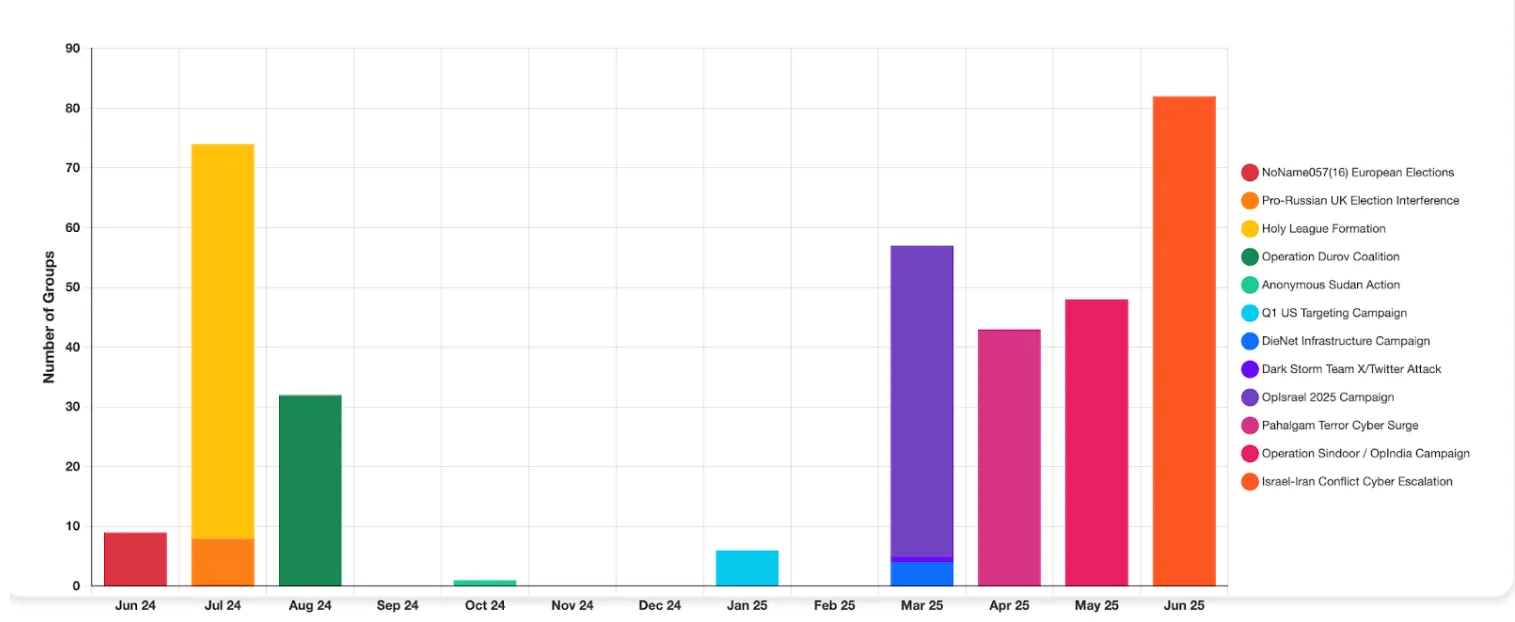
As discussed earlier, cyber warfare is not just about hacker groups or state-sponsored intelligence agencies. In recent years, attacks conducted by hacktivists have assumed an increasingly decisive role in determining the outcome of a conflict. Unlike traditional cyber-attacks by states, hacktivists often act independently or semi-autonomously, yet help create political pressure, destabilize public opinion, and amplify already existing tensions. Some examples of cyber-attacks by hacktivists are: the attack against Russian internet provider Nodex, the attack by the pro-Israel group Predatory Sparrow against Iranian bank Bank Sepah and cryptocurrency exchange Nobitex, DDoS attacks by the pro-Russian group Noname057 against Italian institutional sites and digital services.
Conclusion
The advent of the Internet has brought enormous benefits to humanity, revolutionizing communication, access to information and technological advancement. However, this same advancement can also be exploited for malicious purposes. Cyber warfare is now involved in almost all modern conflicts, where civilians often find themselves involved on the front lines, willingly or unwillingly. Cyber-attacks can have multiple objectives: from spreading misinformation to influencing political decisions, from disrupting communications to restricting access to essential services. For this reason, cybersecurity must be recognized as strategic priority, ensuring that not only governments and businesses, but society as a whole, is adequately protected.