

In the world of cybersecurity, preventing an attack is often more important than detecting it or mitigating its damage. To stay ahead of cybercriminals, it's essential to understand their strategies and techniques so you can counter them in time. Honeypots were created for exactly this purpose: they are "decoy" systems that simulate real environments to lure cybercriminals and study their behavior and goals in a controlled, safe setting.
Among the most innovative solutions in this field stands Beelzebub, an open-source framework created by Mario Candela that integrates artificial intelligence (AI) into traditional honeypots. By leveraging Large Language Models (LLMs), Beelzebub makes it easy and scalable to build high-interaction honeypots, providing a powerful tool to observe, analyze, and anticipate cyberattacks.
In this article, we take a detailed look at what Beelzebub is, how it works, and the benefits it offers.
What is a honeypot?
In cybersecurity, a honeypot - a term that literally means "jar of honey" in English - is a device, such as a server, used as a trap to attract cyberattacks. It presents itself as an easy target for cybercriminals and leverages their intrusion attempts to gather information about them and how they operate, while also distracting them from other targets. The information collected can then be used to strengthen defenses and prevent attacks on critical systems.
Honeypots are created by building security vulnerabilities around them. For example, they may have ports that respond to scanning activity. These vulnerable ports are intentionally left open to lure hackers into the honeypot environment instead of the corporate network. Inside a honeypot, you'll find data crafted to appear confidential, designed to convince attackers they've gained access to a system critical to the organization.
Honeypots can vary based on the complexity of the system:
- A high-interaction honeypot is designed to encourage cybercriminals to spend as much time as possible inside it. This allows more time to analyze the attacker's strategies and objectives.
- A medium-interaction honeypot imitates a real application but doesn't include an operating system. Its purpose is to buy time so the organization can react appropriately to an ongoing attack.
- A low-interaction honeypot requires fewer resources and collects less information about the attacker's methods. While it's relatively easy to implement, it doesn't contain confidential data that might interest an intruder.
Beelzebub
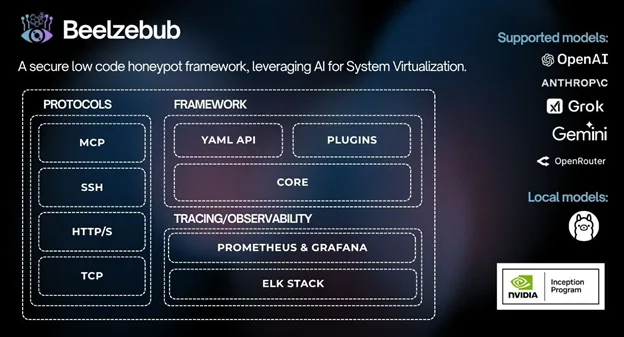
Beelzebub is an open-source framework that uses Large Language Models (LLMs) to simulate high-interaction honeypots completely autonomously. Specifically, the artificial intelligence (AI) acts as a Linux terminal and functions as a high-interaction honeypot on the front-end while operating as a low-interaction honeypot on the back-end. Virtualizing these honeypots through LLMs eliminates the need for continuous human supervision.
Beelzebub has also joined the NVIDIA Inception program, an initiative dedicated to innovative startups working in the fields of artificial intelligence (AI), providing them with technical resources, training, market visibility, and access to the NVIDIA network and its partners.
Functionalities
Beelzebub offers a wide range of functionalities:
• Multi-protocol support: It handles various network protocols, including TCP (Transmission Control Protocol), HTTP (Hypertext Transfer Protocol), HTTPS (Hypertext Transfer Protocol Secure), SSH (Secure Shell), and MCP (Model Context Protocol).
• Simple configuration: You can create a honeypot without writing any code, defining configurations in a simple YAML file.
• Flexible deployment: It supports multiple deployment environments, such as Docker, Kubernetes (via Helm), and the Go compiler, adapting to both local systems and cloud infrastructures.
• Integration with ELK Stack: Beelzebub allows real-time data visualization through Kibana, simplifying the analysis of collected events.
• Monitoring with Prometheus: Thanks to OpenMetrics support, it's possible to collect and analyze honeypot metrics and create custom dashboards in Grafana.
• Integration with RabbitMQ: The messaging broker enables Beelzebub to connect to external systems for notifications or automation.
Conclusion
Its ease of configuration, integration with monitoring tools, and flexible deployment make Beelzebub an extremely valuable tool for cybersecurity professionals. Here at 8Bit, we can only congratulate Mario Candela for developing this framework and, more broadly, for his ongoing support of the community.