
In 2025, the phishing-related cybercrime landscape has undergone a significant transformation with the emergence of automated kits that integrate artificial intelligence components. Among these, InboxPrime AI stands out as a highly sophisticated tool that drastically lowers the technical barrier required to launch credible, large-scale phishing campaigns. Its evolution reflects a broader trend: the industrialization of social engineering and digital fraud techniques, where intelligent automation and advanced defense evasion play a central role.
InboxPrime AI, first observed in October 2025 by researchers at AbnormalAI, is easily accessible within underground communities and is advertised as a "programmatic solution for mass delivery." It even leverages Gmail web interfaces to mimic human behavior and bypass traditional anti-spam filters.
Technical Analysis of the Phishing Kit
The user interface is designed to resemble legitimate SaaS tools, allowing operators to manage accounts, proxies, templates, and campaigns with a level of ease previously reserved for professional email marketing services.
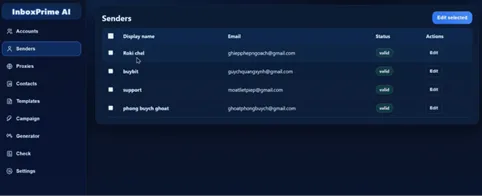
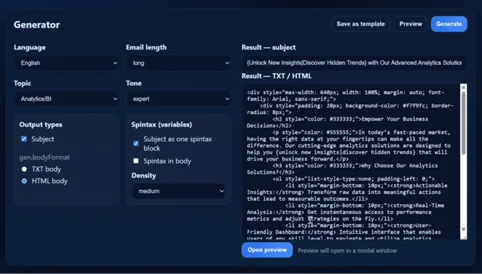
The real innovation introduced by InboxPrime AI is not merely the integration of AI-which has already become a trend even in this "sector"-but how it is integrated. The kit is capable of generating content through artificial intelligence modules, allowing operators to define parameters such as language, industry, message length, and tone. The system produces both text and HTML formats that closely imitate genuine communications, making it difficult for an untrained eye to distinguish a legitimate email from a phishing attempt.
One technically noteworthy feature is the use of spintax for template variation. By generating unique textual variants for each recipient, InboxPrime AI avoids reliance on static signature-based filters, which traditionally block campaigns with repeated or easily recognizable content. This level of dynamic variation significantly increases the likelihood that a message reaches the recipient's inbox rather than being quarantined.
InboxPrime AI also emulates the main anti-spam checks adopted by security vendors, identifying patterns commonly associated with malicious emails and correcting them before delivery. It integrates a spam risk assessment module that automatically analyzes known factors such as suspicious keywords, excessive HTML complexity, and potentially malformed links. Once potential triggers are identified, the system suggests automated corrections to improve "inbox placement," meaning the probability that an email is delivered successfully without triggering anti-spam defenses.
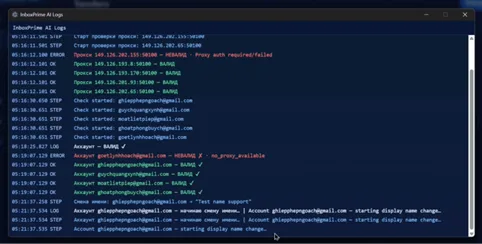
An additional layer of sophistication is provided by sender identity randomization and display name spoofing, achieved through the orchestrated management of compromised or temporary Gmail accounts. These techniques allow attackers to obscure the real origin of the message and impersonate internal roles within the target organization-such as executives, partners, or suppliers-thereby increasing the likelihood that recipients trust the content.
The strength of this kit also lies in its extreme accessibility. First of all, it is easily discoverable on Telegram, making it potentially available to virtually anyone.
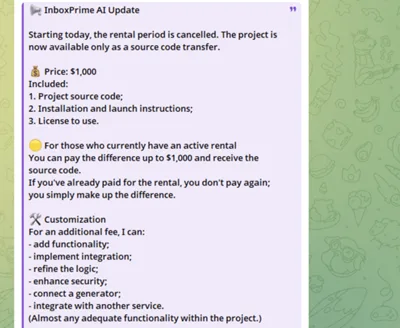
From an economic standpoint, InboxPrime AI has transitioned from a phishing-as-a-service (MaaS) model to a lifetime license sold for approximately one thousand US dollars. This means that, for a relatively affordable price, any criminal group or individual can gain access to complex software for the preparation and management of phishing campaigns.
The Evolution of Phishing Kits as a Service
InboxPrime AI is part of a new generation of phishing kits that increasingly incorporate artificial intelligence into cybercriminal operations. Recent research documents other sophisticated kits such as BlackForce, GhostFrame, and Spiderman, which facilitate large-scale credential theft and attempt to bypass security controls such as multi-factor authentication (MFA).
BlackForce, for example, is designed to carry out Man-in-the-Browser (MitB) attacks that intercept not only usernames and passwords, but also OTP codes generated by authenticator apps or SMS, effectively bypassing MFA defenses that many enterprise environments consider robust. This represents a level of sophistication where automation is no longer limited to message generation, but extends to active compromise and traffic manipulation techniques.
GhostFrame leverages hidden iframes and randomized subdomains to evade both static and dynamic analysis, while Spiderman allows attackers to restrict access to phishing pages based on geographic or device-based criteria, thereby reducing noise and limiting exposure to detection systems.
Phishing is evolving from a relatively simple social engineering tactic into an automated, modular, and layered discipline, where the agility of artificial intelligence accelerates content creation and campaign scalability.
Mitigation Techniques
From a SOC perspective, traditional secure email gateway (SEG) systems are often centered around fixed rules: textual patterns, domain blacklists, and superficial sender analysis. The fact that a phishing kit can generate millions of textual combinations and impersonate legitimate sending behaviors renders these methods obsolete or largely ineffective.
In parallel, the increasing adoption of machine learning and deep learning-based detection models-such as those described in recent academic research (including Phishsense-1B)-clearly demonstrates the possibility of overcoming the historical limitations of traditional filtering systems. These approaches achieve higher accuracy and improved generalization capabilities when distinguishing between legitimate emails and phishing attempts. Rather than relying on rigid indicators or static signatures, these models operate on a combination of contextual signals, linguistic features, and semantic coherence, attempting to reconstruct the overall intent of a message instead of merely checking for suspicious patterns.
At the same time, however, the use of artificial intelligence in both defensive platforms and offensive tools introduces new complexities that cannot be ignored. Even highly advanced models can produce false negatives if trained on partial, biased, or outdated datasets, and in some cases may be deliberately bypassed through adversarial machine learning techniques. For this reason, the most effective defensive strategies in practice tend to avoid blind reliance on automation, instead favoring a more balanced approach in which intelligent detection is complemented by multi-layer validation processes, continuous user training, and strengthened awareness of context and sender identity.
Conclusions
InboxPrime AI can be considered a turning point in the cybercrime economy due to its ability to integrate extremely advanced phishing techniques with the development of software that rivals professional-grade products. It fits into a broader ecosystem of advanced kits that increasingly challenge organizational defensive capabilities, within a threat domain-phishing-that has historically proven particularly difficult to contain.
Identifying effective detection techniques requires a rethinking of defensive technologies, moving toward behavioral and machine learning-based systems, while also reinforcing human and procedural security practices.